Two Callbacks, Two Outcomes: What a Home Inspection Business Really Loses When It Handles Complaints by Gut
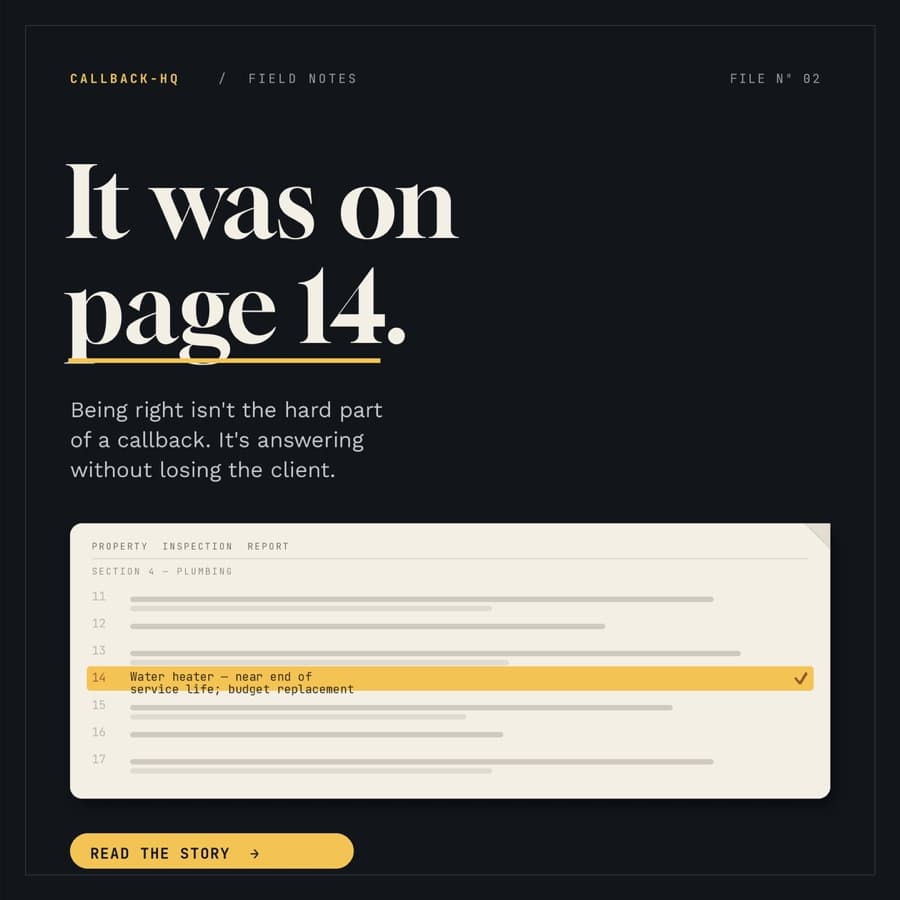
Every home inspector knows the feeling. The report went out days ago. The job is closed, the invoice paid, the file mentally filed away. Then the phone rings, or an email lands with a subject line that starts with “Concern about the inspection…” — and a closed job is suddenly open again.
Callbacks are not the problem. Callbacks are part of the business. The problem is what they cost you to answer well, and what they cost you when you answer badly. Below are two callbacks that land on the same busy owner's desk in the same week. One is baseless. One is legitimate. How each is handled tells you almost everything about why a tool like Callback-HQ exists.
Callback #1: The complaint that was already answered — in the report
A buyer moves into their new home and, three weeks later, notices the water heater is near the end of its service life. They're upset. They call the inspection company convinced something was missed, and the tone is not friendly: “You inspected this house and never told me the water heater was old.”
Here's the thing. It wasin the report. Page 14, plumbing section, with a photo of the manufacturer's data plate, the estimated age, and a plainly worded note: “Water heater is at or near the end of its typical service life; budget for replacement.” The inspector did the job correctly. The finding is documented, photographed, and dated. This is a baseless callback in the truest sense — the answer already exists in the deliverable the client paid for.
And this is exactly where a busy owner gets into trouble.
Because the complaint is frivolous, it's tempting to treat it as frivolous. The owner is running two crews, juggling scheduling, and staring at a claim that is obviously wrong. So the reply — fired off between site visits — reads something like: “This was noted in your report on page 14. Please review it.” Technically correct. Completely tone-deaf.
The client doesn't hear “here's your answer.” They hear “you didn't read carefully enough, and I don't have time for you.” Now they're not just worried about a water heater — they're insulted. So they escalate. They call the real estate agent who referred the inspector in the first place: “Your guy blew me off.”
That phone call is the expensive part. The agent doesn't care who's technically right. The agent cares that their client — the client whose future referrals, reviews, and repeat business the agent is counting on — is angry, and that the anger now has the agent's name attached to it. One curt email has quietly put an entire referral relationship at risk. In an industry where a single active agent can be worth dozens of jobs a year, dismissing a frivolous callback carelessly can cost far more than the callback ever could.
What Callback-HQ does with a baseless callback
Feed that same complaint into Callback-HQ and the sequence changes completely. The system ingests the complaint, pulls the original report, and locates the relevant finding — the page 14 water-heater note, the photo, the timestamp. It confirms, with evidence, that the item was disclosed. Then it drafts a response that leads with the customer, not the file: it acknowledges the buyer's frustration, walks them to exactly where the information lives in the report they already have, and does it in a professional, empathetic tone that closes the loop instead of picking a fight.
The owner reviews a ready-to-send letter in under a minute instead of composing a defensive one-liner from a job site. The client feels heard. The agent never gets the angry phone call, because there's nothing to be angry about. A callback that could have cost a referral relationship becomes a non-event — which is precisely what a correctly documented finding deserves.
Callback #2: The one where the inspector actually missed it
Same week, different call. A homeowner reports a leak under a bathroom vanity. This time the review isn't as comfortable: the report has no note on that fixture, no photo, no disclaimer about access being blocked. It looks like a genuine miss. Not negligence, not a pattern — the kind of honest oversight that happens in a profession that inspects thousands of components under time pressure. But a miss all the same.
This is the callback that keeps owners up at night, because now the questions get hard. Do we owe anything? How much? What do we put in writing? Say too much and you've admitted liability you didn't need to. Say too little and the client — rightly annoyed — heads for a review site or a lawyer. Guess wrong on the dollar figure and you've either overpaid or inflamed the situation. For a busy owner, this is an hour of stress and second-guessing minimum, usually more.
What Callback-HQ does with a legitimate miss
Callback-HQ reads the complaint against the report and reaches the honest conclusion: this item wasn't documented, and the company shares responsibility. Rather than leaving the owner to agonize over the number, it analyzes the issue and recommends a fair, proportionate resolution — in this case, a $400 contributiontoward the repair. Not the whole invoice, not a reflexive brush-off. A defensible middle figure that reflects the company's actual share of the problem.
From there it produces the paperwork that makes the resolution clean:
- A goodwill contribution letter to the homeowner, professional in tone, that takes appropriate responsibility without over-conceding, states the contribution clearly, and frames the company as one that stands behind its work.
- A release to accompany the payment, so the $400 closes the matter rather than becoming a down payment on further demands.
The owner reviews, approves, and sends. What would have been an hour of anxious drafting and a coin-flip on the dollar amount becomes a few minutes of review. The homeowner gets a fast, fair, professional resolution — the kind of experience that turns a legitimate complaint into a five-star review about how well the company handled it.
The real cost isn't the callback. It's the response.
Line the two up and the pattern is obvious. One callback was baseless; one was legitimate. Handled by hand, on a busy day, both were landmines: the frivolous one nearly cost a referral relationship because it was dismissed too curtly, and the real one threatened to cost time, money, and reputation because there was no fast way to size it up. Handled by Callback-HQ, both were resolved in minutes with the right tone, the right evidence, and — when warranted — the right dollar figure and the right release.
For an owner running the business, that's the whole point. Callback-HQ isn't there to make callbacks disappear. It's there so that every callback, baseless or legitimate, gets the calm, documented, customer-first response it deserves — without pulling you off a job site to write it, and without one hurried email quietly costing you an agent, a client, or a reputation you spent years building.